Planning to see the Moalboal sardine run? It's not the seasonal South African event — it's a near-daily bait ball off the shore. Here's how it works and how to see it well.
If you've searched "Moalboal sardine run," there's a good chance you first came across photos of South Africa's sardine run — the dramatic, predator-chased migration that fills nature documentaries. Moalboal's is a different animal entirely, and understanding that difference is the most useful thing this guide can tell you before you plan around it.
This is written for anyone deciding whether to build a Moalboal trip around the sardine run, and what to actually expect once you're in the water.
It's not a seasonal migration — it's a resident bait ball
South Africa's sardine run is an annual event: billions of sardines move along the coastline for a few weeks each winter, trailed by dolphins, sharks and seabirds in one of the most-filmed feeding frenzies in the ocean.
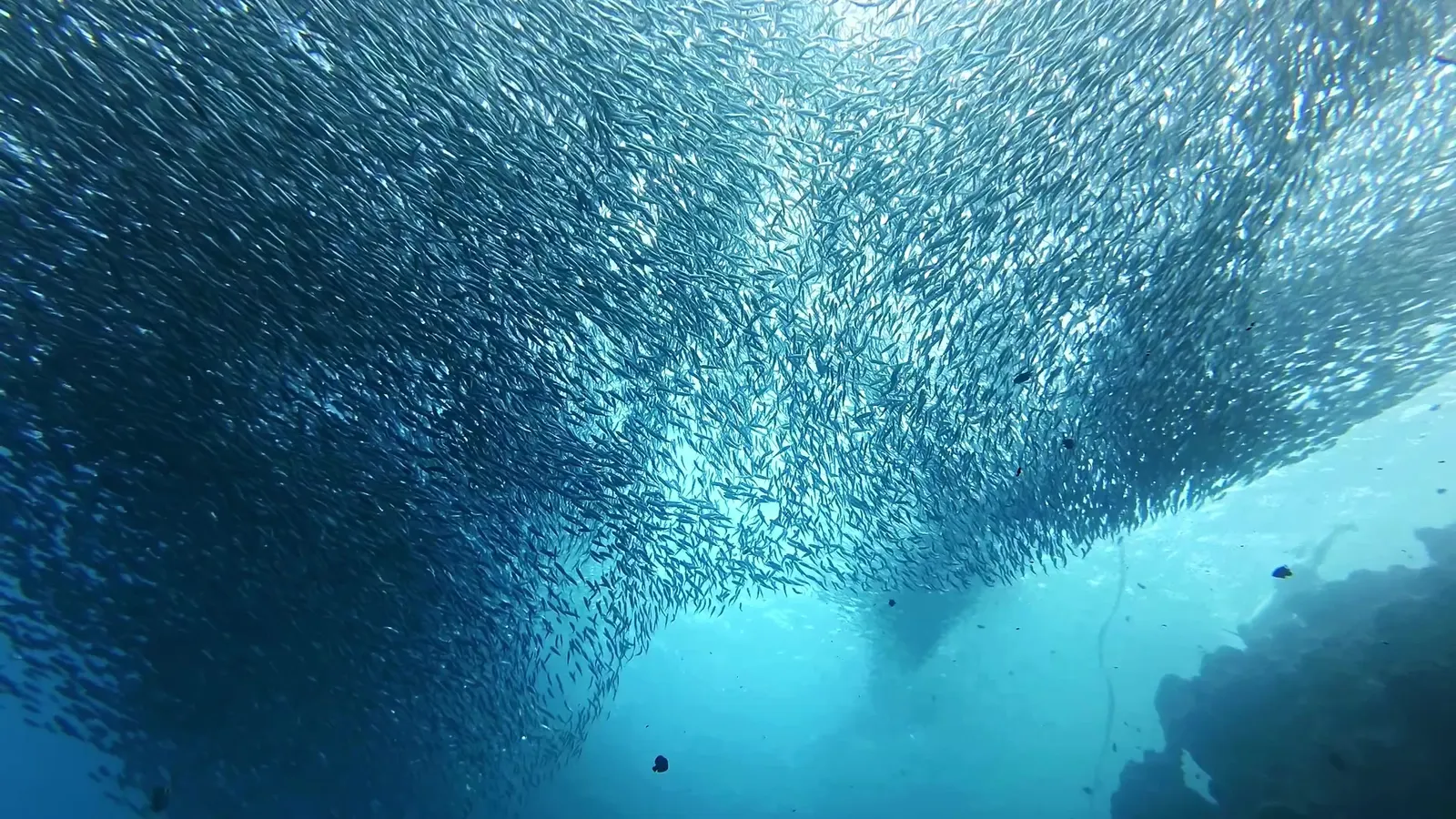
Moalboal's sardine run is something else. A dense ball of sardines has lived just off the shore near Panagsama and White Beach for years, apparently drawn to the deep drop-off and the nutrient-rich water along it. It isn't migrating anywhere, and it isn't tied to a season. On most days, it's simply there.
That's the headline fact worth planning around: you don't need to time a specific month or week. You need to time a trip to Moalboal, and then check conditions on the day.
What actually affects whether you see it well
Since it's a near-daily phenomenon rather than a seasonal one, the variables that matter are smaller and more local:
- Current and visibility. On calm, clear days the ball is denser and easier to find close to shore. After a storm or on a choppy day, it can be more scattered or sit further out.
- Time of day. Mornings tend to be calmer, with less boat traffic from day-trippers, which generally makes for an easier, less crowded encounter. That said, the ball itself doesn't follow a strict daily schedule the way tides do — ask locally on the morning of your visit.
- Where you enter the water. Most shore-diving and shore-snorkeling resorts along Panagsama and White Beach sit close enough to walk straight in. Which exact stretch of beach the ball sits off can shift slightly day to day.
None of this requires advance booking months out the way, say, whale shark season elsewhere might. It mostly rewards asking your resort or dive shop the same morning.
Snorkeling vs diving
You don't need to dive to see it. The ball typically sits in water shallow enough that snorkelers swim straight through it from the shore — no boat, no tank, just fins and a mask. This is one of the reasons Moalboal is unusual among dive destinations: one of its signature sights is a snorkel experience, not an exclusively scuba one.
Divers see it too, usually on a shore dive that passes through or alongside the ball on the way to the drop-off, and the ball can also be visible from below in a way snorkelers on the surface don't get.
Neither approach is "better" — it depends on whether you dive. If you don't, that's not a reason to skip Moalboal.
What it's actually like in the water
A few things that make the experience better, based on what repeat visitors and dive staff consistently mention:
- Full-face masks help first-timers. They remove the mouthpiece-breathing adjustment that trips up a lot of new snorkelers, letting you focus on the fish instead of your breathing.
- Natural light does the work, not a strobe. Because the ball sits in shallow, bright water, a basic action camera or phone in a waterproof case captures it well without needing dive lighting.
- Don't chase the ball. It responds to movement, and sardines part and reform around a swimmer who stays relatively still far better than one who swims straight at the centre. Drift into it, don't charge it.
- Combine it with Pescador Island. A short boat ride from the same stretch of coast, Pescador Island is a separate and distinctly different sight — walls, reef life and a marine-protected-area setting — worth treating as a second, complementary outing rather than a substitute for the shore-based sardine run.
Who this is and isn't for
It suits confident swimmers and snorkelers comfortable in open water with some current, including first-timers using a flotation aid or full-face mask under supervision. It is not the right first experience for a non-swimmer without one-on-one support, since entry is directly into open water rather than a shallow, enclosed pool.
Setting expectations
The ball has been a fixture off Moalboal for well over a decade, which is reassuring, but it is a wild phenomenon, not a managed exhibit. Density, position and visibility vary with the day. Most multi-day stays see it clearly at least once; a single rushed visit on a rough day has more variability. If the sardine run is the main reason for your trip, build in more than one morning rather than a single attempt.
Where Blue Orchid Resort fits
We sit on the beach at Saavedra, Moalboal, with shore access to the sardine run without a boat — guests walk off our beach into it. We provide complimentary full-face snorkel masks, and our dive team can tell you, each morning, roughly where conditions look best that day.
For the dive-side experience, including shore dives through the sardine run and trips out to Pescador Island, see our diving page and dive sites. To plan a stay around it, see accommodation or get in touch with your dates.
Frequently asked questions
Is the Moalboal sardine run the same as the sardine run in South Africa?
No, and the name causes real confusion. South Africa's sardine run is a seasonal migration that happens once a year, over a few weeks in winter, and draws the fish into huge, briefly-passing shoals chased by predators. Moalboal's sardines are a resident bait ball that has lived just off Panagsama/White Beach for years — not migrating, not seasonal, and visible on most days of the year, weather allowing.
What is the best time of day to see the Moalboal sardine run?
Morning is generally the most reliable window, when the water tends to be calmer and the beach has less boat traffic, but the exact timing and density of the ball shifts with current, light and the day's conditions. Ask your dive shop or resort on the morning itself rather than planning around a fixed hour.
Do I need to dive to see the sardine run, or can I snorkel it?
Snorkeling is enough, and most visitors see it that way. The bait ball sits close enough to shore that it is a shore-entry snorkel for most resorts on Panagsama/White Beach, no boat required. Divers also swim through and around it, usually as part of a shore dive, but it is not a dive-only sight.
Is the sardine run suitable for beginners and non-swimmers?
It suits confident swimmers and snorkelers comfortable in open water with some current, including first-time snorkelers with a flotation aid or full-face mask. It is not suitable for non-swimmers without one-on-one supervision, since the entry point is open water, not a shallow pool.
Can the sardine run disappear or move away?
The ball has been a fixture off Moalboal for well over a decade, but its exact position, depth and density do shift day to day with current and conditions, and on a rough or murky day it can be harder to find or less dense than usual. It is not guaranteed on any single visit, though the odds are good across a multi-day stay.
Written by Blue Orchid Resort · Updated November 15, 2026